National EPA

DRAFT FOR CONSULTATION

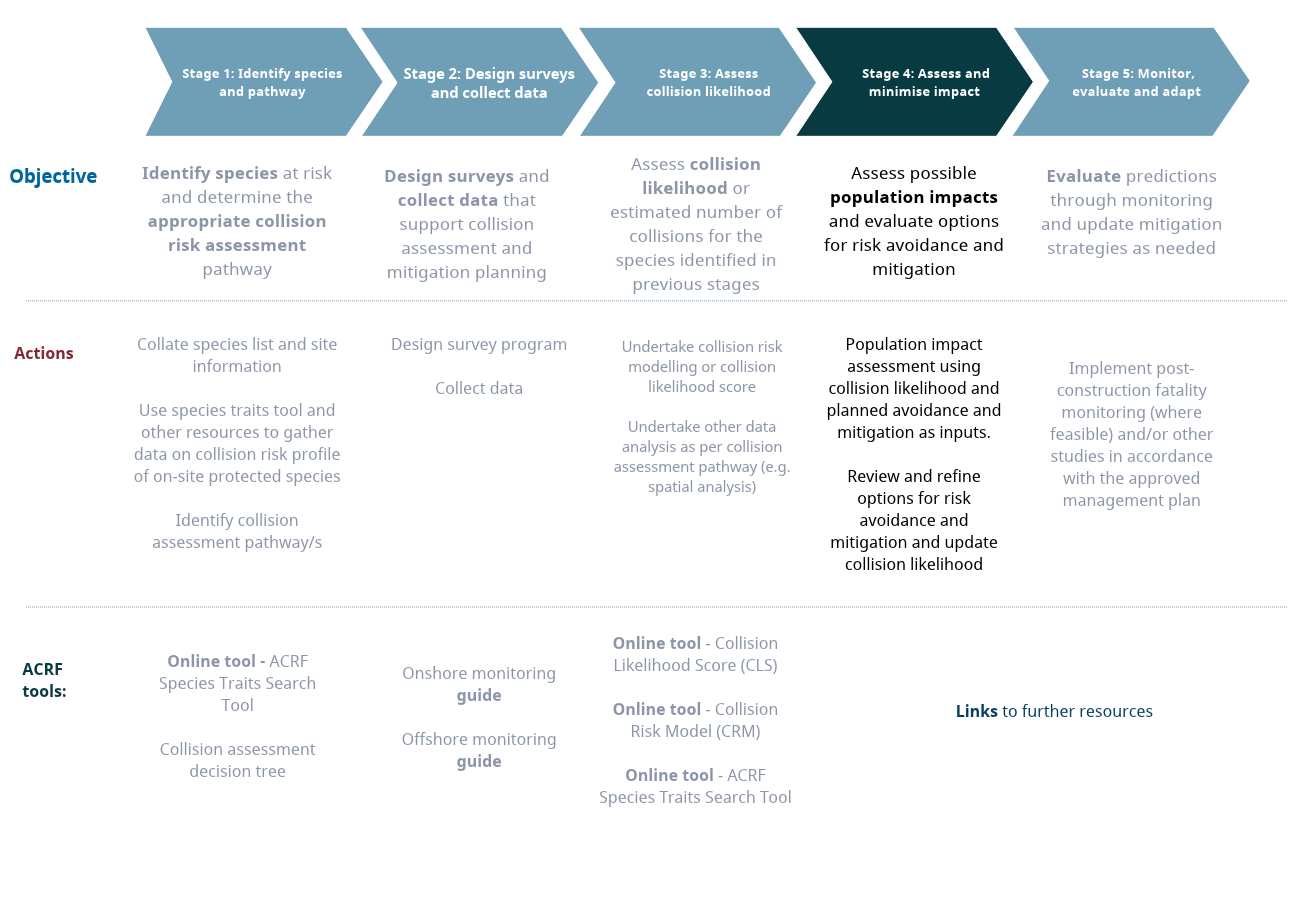
Stage 4: Assess and minimise impact

Stage 4: Assess and minimise impact

Assess possible population impacts and evaluate options for risk avoidance and mitigation

Objective and scope

The primary focus of the ACRF and associated tools is the assessment and communication of bird and bat collision likelihood. Collision likelihood is only one component of environmental impact assessment. Stage 4 considers the potential population-level consequences of predicted collision mortality and opportunities to avoid and minimise collision impacts.

Stage 4 brings together the evidence generated through previous stages with information on population size, trends, conservation status, existing threats and other sources of mortality. The appropriate approach to assessing population-level consequences will depend on the species, population, quality of available information and predicted collision mortality. The ACRF does not prescribe a single population-level assessment method; detailed population modelling, repair and compensation assessment are beyond its scope.

In practice stages 3 and 4 may be iterative — updated CRM and CLS assessments can demonstrate the harm reduction achieved through avoidance and mitigation measures developed during this stage.

Key questions: What are the potential population-level consequences of predicted collision mortality? How does the predicted impact compare with the population’s conservation status, trends, objectives and existing threats? What opportunities exist to avoid and mitigate collision impacts? What is the residual population-level impact after avoidance and mitigation measures have been applied? What are the key assumptions, uncertainties and limitations affecting the conclusions?

Spatial scope: The project site and relevant surrounding area, together with the population or geographic area relevant to assessing population-level consequences.

Project timing: Stage 4 should commence as collision likelihood information becomes available and continue through project design and environmental assessment. Stages 3 and 4 may be iterative where changes to project design, turbine specifications or mitigation measures alter predicted collision likelihood or its potential consequences.

Key Activities:

  • Assess population-level consequences of predicted collision mortality.
  • Assess measures to reduce collision likelihood.
  • Integrate findings and determine residual impact.
  • Outputs:

  • Population consequence assessment: A documented assessment of the potential population-level consequences of predicted collision mortality, proportionate to the potential impact and available evidence.
  • Population and conservation evidence: Documentation of relevant population information, including population size, distribution, trends, demographics, conservation status, existing threats and recovery objectives, where available.
  • Avoidance and mitigation: Documentation of measures considered or adopted to avoid and mitigate collision impacts, including relevant project design, siting, layout, turbine configuration and operational measures.
  • Updated collision assessment: Where project design or operational measures materially change collision likelihood, an updated Stage 3 collision assessment or scenario analysis, as appropriate.
  • Residual impact: A documented assessment of residual collision likelihood or predicted mortality, its potential population-level consequences and significance after avoidance and mitigation measures have been incorporated.
  • Environmental assessment integration: Integration of collision likelihood, population consequences and residual impacts into the broader environmental assessment and relevant approval documentation.
  • Residual uncertainty and monitoring needs: Identification of key residual uncertainties and, where appropriate, the monitoring or information needs that should be addressed through Stage 5.
  • Supporting documentation: Clear documentation of the evidence, methods, assumptions, uncertainties and reasoning underpinning the assessment and conclusions.
  • Objective and scope
    Photo by Symbolix

    Documents and applications

  • ACRF Guidance document provides detailed information to help navigate this stage and the ACRF as a whole
  • See Resources for additional tools and references relevant to this stage.
  • Third party resources

  • The Renewables Environmental Research Initiative is publishing new science and online tools that are useful for quantifying the level of impact to local bird and bat populations from the predicted collision likelihood.
  • Significant Impact Guidelines – Commonwealth guidance for considering whether an action is likely to have a significant impact on Matters of National Environmental Significance. EPBC Act publications and resources - DCCEEW
  • EPBC Act environmental assessment and approvals guidance – Provides information on environmental assessment, avoidance and mitigation, approval requirements and associated conditions. EPBC Act publications and resources - DCCEEW
  • Commonwealth environmental offsets and compensation guidance – Relevant where residual impacts require consideration of compensation or offsets under the applicable Commonwealth framework. EPBC Act publications and resources - DCCEEW
  • Relevant State and Territory environmental assessment resources – Applicable where the project is also subject to State or Territory environmental assessment, conservation or approval requirements.
  • Other Resources
  • Third party resources
    Photo by Eco Aerial