National EPA

DRAFT FOR CONSULTATION

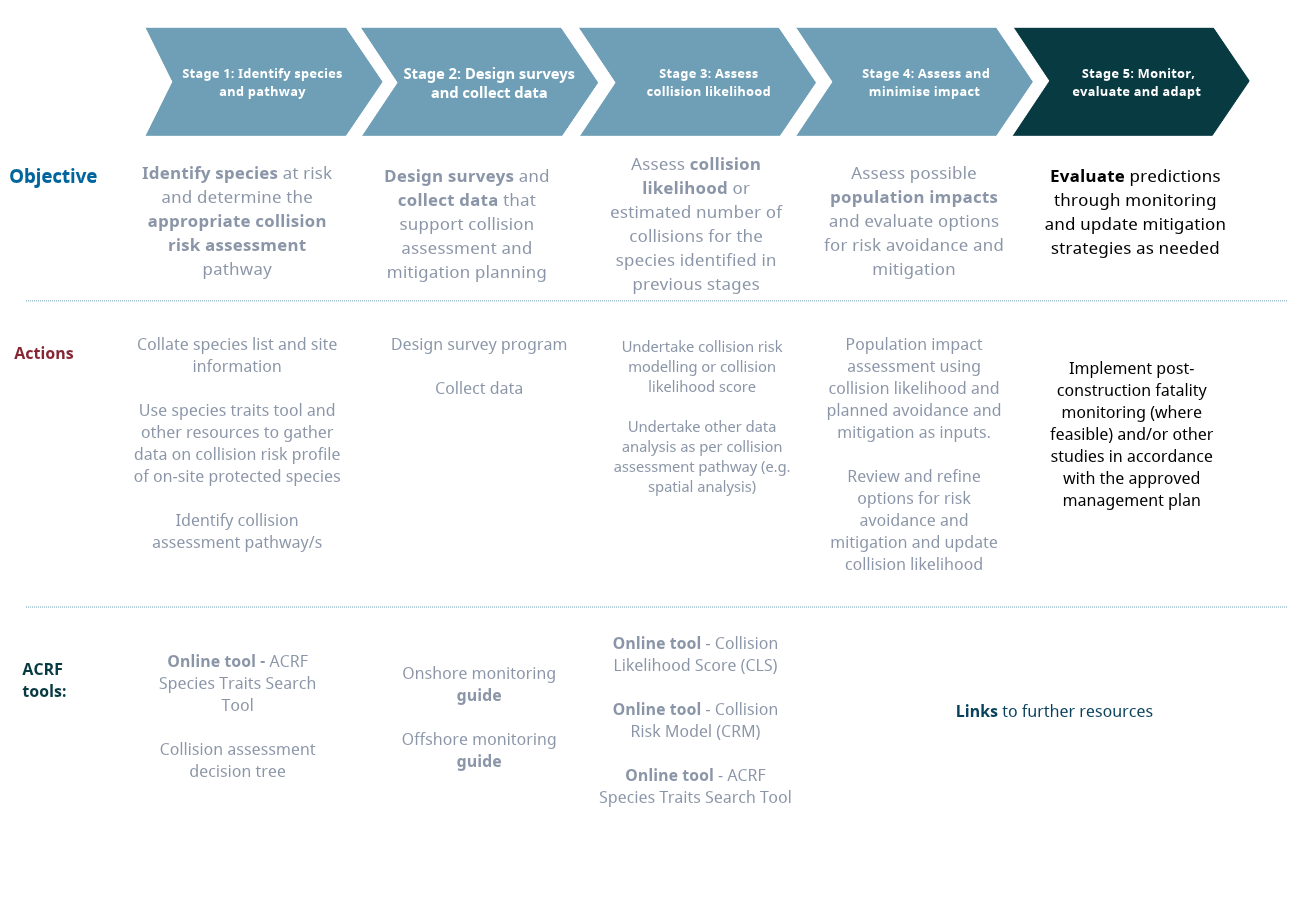
Stage 5: Monitor, evaluate and adapt

Stage 5: Monitor, evaluate and adapt

Evaluate predictions through monitoring and update mitigation strategies as needed

Objective and scope

Stage 5 evaluates post-construction observations against the assumptions, predictions and collision risk drivers underpinning the pre-construction assessment, and uses the findings to inform adaptive management and future assessments. It closes the feedback loop established through Stages 1–4 without requiring the pre-construction assessment to be reproduced after construction.

Key questions: How do post-construction observations compare with pre-construction predictions and assumptions? Are avoidance and mitigation measures performing as expected? Are post-construction outcomes consistent with the residual impact identified in Stage 4? Is additional monitoring, mitigation or adaptive management required? What information from post-construction monitoring can improve future collision risk assessments and management?

Spatial scope: Project site and associated monitoring areas.

Project timing: Following construction and during project operation, in accordance with approval conditions, management plans and the monitoring requirements established through the environmental assessment. Monitoring and evaluation should be reviewed periodically and may be refined where new information indicates that changes are warranted.

Key Activities:

  • Implement post-construction monitoring and targeted studies in accordance with approval conditions and management plans.
  • Compare observations with pre-construction predictions and assumptions.
  • Evaluate mitigation effectiveness and adapt management where required.
  • Use monitoring outcomes to improve future collision risk assessments, mitigation approaches and research priorities.
  • Outcomes:

  • Monitoring and reporting: Post-construction monitoring and reporting undertaken in accordance with approval conditions and management plans.
  • Monitoring results: Documentation of post-construction monitoring results and targeted studies relevant to collision risk.
  • Evaluation of predictions and assumptions: A documented evaluation of post-construction findings against pre-construction predictions, assumptions and key collision risk drivers, where feasible.
  • Mitigation effectiveness: Documentation of the effectiveness of avoidance and mitigation measures, including any limitations or unexpected outcomes.
  • Adaptive management: Documentation of any adaptive management actions undertaken in response to monitoring results, including the basis for those actions.
  • Lessons and evidence: Identification of key lessons, remaining uncertainties and opportunities to improve future collision risk assessments, mitigation approaches and research priorities.
  • Objective and scope
    Photo by Symbolix

    Documents

  • ACRF Guidance document provides detailed information to help navigate this stage and the ACRF as a whole
  • Third party resources

  • The REWI Research Hub is a searchable catalog of wildlife risk minimisation technologies for renewable energy facilities.
  • Post-construction Bird and Bat Fatality Monitoring for Onshore Wind Energy Facilities in Emerging Market Countries is a recent, comprehensive guide to post-construction monitoring international practice.
  • Other Resources
  • Third party resources
    Photo by Mimadeo