
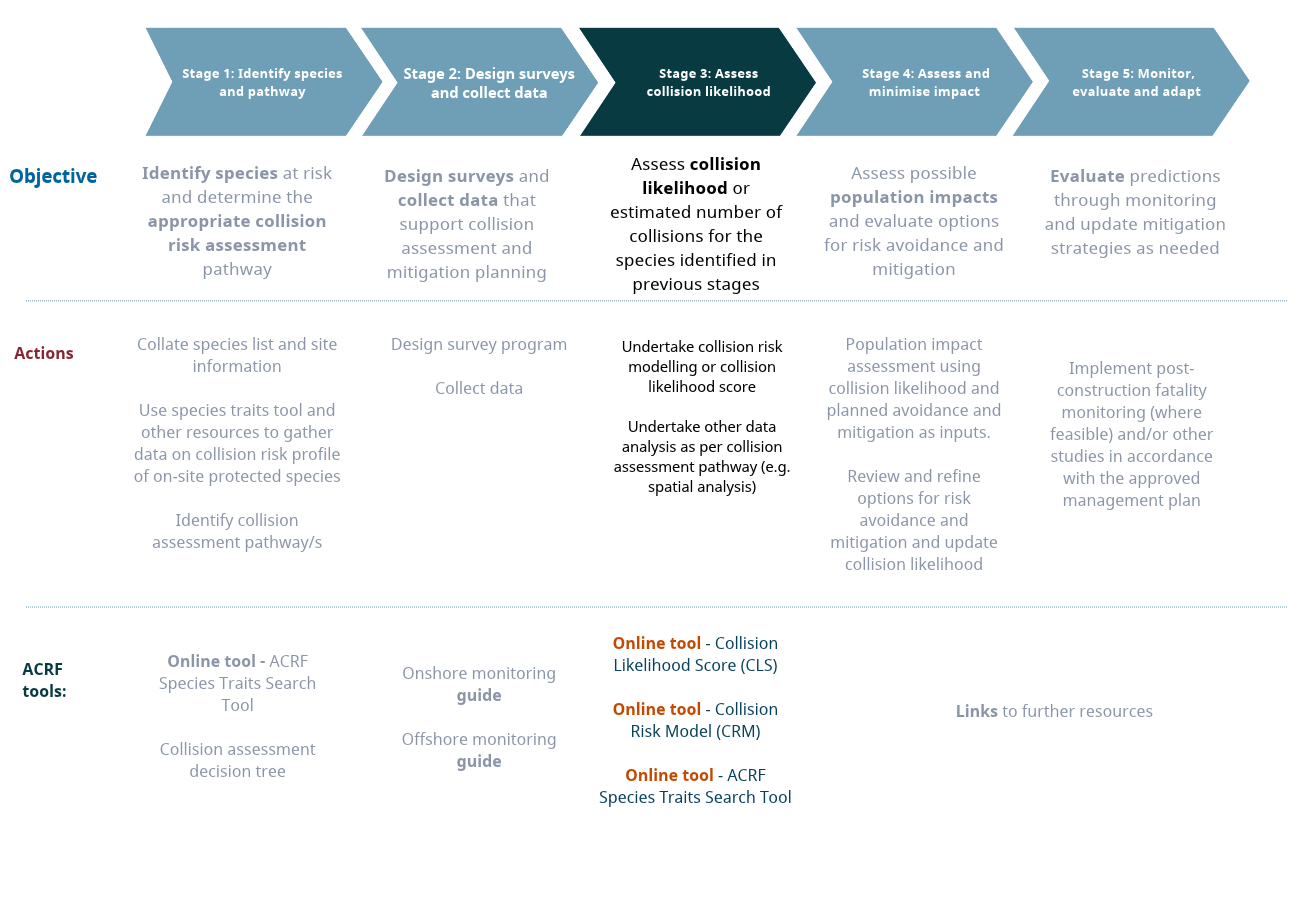
Stage 3: Assess collision likelihood
Stage 3: Assess collision likelihood
Assess collision likelihood or estimated number of collisions for the species identified in previous stages.
Objective and scope
The information collected in Stage 2 should provide the evidence required to assess collision likelihood for species identified in earlier stages or identify any remaining limitations that need to be addressed.
Collision assessment should not be viewed solely as a reporting requirement. Applying the assessment tools while project design remains flexible can help identify high-risk locations, periods or behaviours and provide opportunities to avoid or minimise collision likelihood through project planning, consistent with the mitigation hierarchy.
Stage 3 focuses on assessing collision likelihood using the selected Collision Risk Model (CRM), Collision Likelihood Score (CLS), or hybrid approach. The outputs provide an evidence base for Stage 4, where collision likelihood is considered alongside population and conservation information to assess potential consequences and significance and identify appropriate avoidance and mitigation measures.
Key questions: What is the assessed collision likelihood or predicted annual collision rate for each species of concern? What factors are driving collision likelihood? What avoidance or minimisation opportunities are identified by the assessment? What are the key assumptions uncertainties and limitations?
Spatial scope: Project area and relevant surrounding area, at a scale appropriate to the species, site and assessment pathway.
Project timing: Following collection of sufficient evidence through Stage 2 and during environmental assessment. Stage 3 may be undertaken iteratively as project layouts, mitigation measures, assessment outcomes and relevant new information evolve.
Key Activities:
Outputs:
Documents and applications
Third party resources
